EN English
CN 中文
FR Français
ES Español
PT Português
RU Русский
Generator Solution Framework

Telecom Remote Site Power

Hybrid solar-diesel power systems for remote telecom towers, base stations, and communication sites. Reduce fuel consumption by 60–80%, extend service intervals, and maintain 99.9%+ uptime with intelligent energy management and remote monitoring.

Reliable Power for Remote Communication Infrastructure

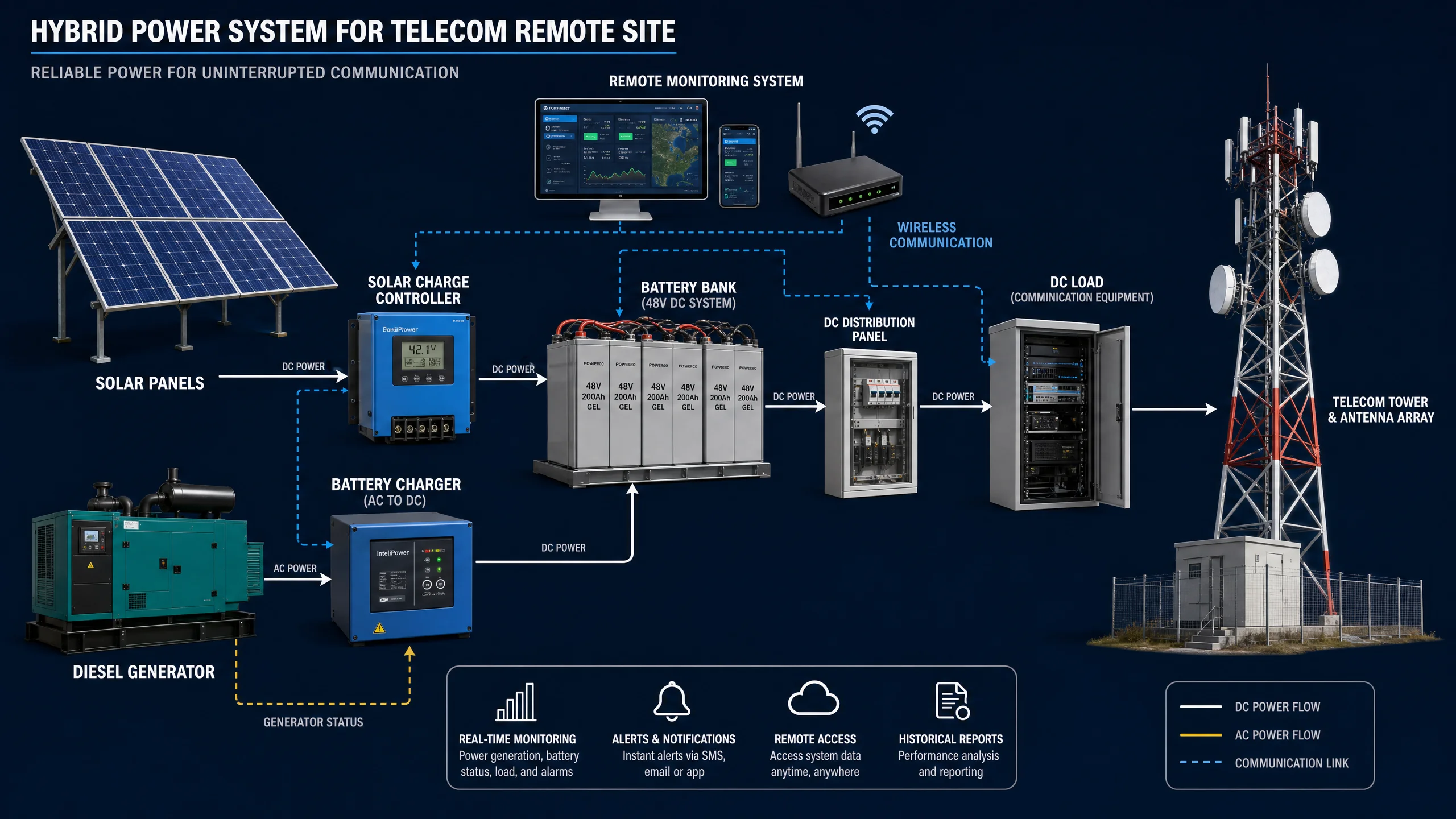
Remote telecom towers and base stations are the backbone of mobile networks, yet they often operate in locations with no grid access, extreme climates, and difficult logistics. A power failure at a remote site can take hours or days to repair, causing widespread network outages. Traditional diesel-only power systems require frequent fuel deliveries and maintenance visits, driving high operating costs. Hybrid solar-diesel systems with battery storage can reduce fuel consumption by 60–80%, extend generator service intervals to 3–6 months, and provide continuous power even when the generator is off. SolutionMall provides complete hybrid power systems for telecom sites from 1 kW to 50 kW.
Telecom Remote Site Power

Remote Telecom Site Power Challenges

Grid Unavailability
Remote sites have no utility grid connection. All power must be generated on-site from diesel, solar, wind, or a combination of sources.
High Fuel Logistics Cost
Diesel delivery to remote sites by truck or helicopter is expensive and unreliable. Minimizing fuel consumption is critical to reducing operating costs.
Extreme Climate Conditions
Remote sites may experience temperatures from -40°C to +55°C, high humidity, dust, salt air, and high altitude. All equipment must be rated for the specific site conditions.
Minimal Maintenance Access
Remote sites may be visited only once every 3–6 months. Equipment must be highly reliable, self-diagnosing, and remotely manageable.
Battery Performance in Extreme Temperatures
Lead-acid and lithium batteries have reduced capacity and shorter life in extreme temperatures. Thermal management is essential for battery-based systems.
Remote Monitoring Connectivity
Monitoring data must be transmitted over the same telecom network being powered, or via satellite. Communication system reliability is critical.

Hybrid Solar-Diesel Telecom Power System

The hybrid system consists of solar panels charging a battery bank through a solar charge controller. The battery bank powers the telecom equipment directly via a DC distribution panel. A diesel generator with an AC-DC battery charger provides backup charging when solar energy is insufficient. An energy management controller optimizes the balance between solar, battery, and generator power to minimize fuel consumption while maintaining required battery state of charge. Remote monitoring transmits system data via the telecom network or satellite.

01
Telecom-Grade Diesel Generator
1–20 kW diesel generator specifically designed for telecom applications. Low fuel consumption at partial load, extended service intervals (500–1000 hours), weatherproof enclosure, and remote start capability.
02
Solar PV Array
Monocrystalline or polycrystalline solar panels sized to provide 60–80% of average daily energy requirement. Mounted on ground frames or rooftop structures with anti-theft fasteners.
03
Battery Bank
VRLA (AGM/Gel) or lithium iron phosphate (LiFePO4) batteries providing 24–72 hours of autonomy at full telecom load. Temperature-compensated charging for extended battery life.
04
Solar Charge Controller (MPPT)
Maximum Power Point Tracking charge controller optimizing solar energy harvest. Integrated with energy management system for intelligent charging strategy.
05
Energy Management Controller
Intelligent controller that monitors battery state of charge, solar generation, and load demand. Automatically starts generator when battery reaches low threshold and stops when battery is recharged.
06
Remote Monitoring Unit
IoT monitoring device transmitting real-time data on solar generation, battery status, generator runtime, fuel level, and alarm conditions via GSM/GPRS, satellite, or the telecom network itself.

Telecom Site Power Applications

Mobile Network Base Stations
4G/5G base stations in rural and remote areas. Hybrid power reduces fuel costs and maintenance visits while maintaining 99.9%+ network uptime.
Microwave Relay Stations
Point-to-point microwave links on hilltops and mountain passes. Small hybrid systems (1–5 kW) with extended battery autonomy for infrequent maintenance access.
Satellite Ground Stations
Remote satellite communication sites requiring highly reliable power for sensitive RF equipment. UPS-grade power quality with generator backup.
Border and Security Posts
Remote government communication and surveillance infrastructure requiring reliable power with minimal human presence.

Telecom Hybrid Power System Implementation

1
Site Energy Assessment
Measure or estimate telecom equipment power consumption (typically 0.5–5 kW). Obtain solar irradiation data for site location. Assess fuel delivery logistics and cost.
2
Hybrid System Sizing
Size solar array, battery bank, and generator based on energy balance analysis. Target solar fraction of 60–80% to minimize fuel consumption while maintaining required autonomy.
3
Equipment Selection for Site Conditions
Select all components rated for site temperature range, altitude, humidity, and seismic conditions. Verify battery chemistry suitability for temperature extremes.
4
Installation and Commissioning
Install solar panels, battery bank, charge controller, generator, and monitoring system. Commission energy management controller with site-specific parameters.
5
Remote Monitoring Setup
Configure monitoring system with alarm thresholds, reporting intervals, and escalation procedures. Test remote start and stop of generator via monitoring system.
6
Performance Optimization
Monitor system performance for first 3 months. Adjust energy management parameters to optimize solar fraction and battery cycling for site-specific conditions.

Products for Telecom Remote Site Power

Telecom Diesel Generator 1–20 kW
Purpose-built telecom generators with low fuel consumption, extended service intervals, and remote start capability. Weatherproof enclosures for harsh environments.
Solar PV Modules
High-efficiency monocrystalline solar panels for remote telecom sites. Anti-reflective coating, salt-mist corrosion resistance, and IEC 61215 certified.
Telecom Battery Bank (VRLA/LiFePO4)
Deep-cycle batteries for telecom hybrid systems. VRLA AGM/Gel for moderate climates, LiFePO4 for extreme temperature sites. 5–10 year design life.
Hybrid Energy Management Controller
Intelligent energy management system for solar-diesel-battery hybrid systems. Optimizes fuel consumption, extends battery life, and provides remote monitoring interface.

Optimize Your Remote Telecom Site Power

Submit your site location, telecom load, and fuel cost data. Our engineers will design a hybrid power system to minimize your operating costs.