
Standby Power
Solution Overview
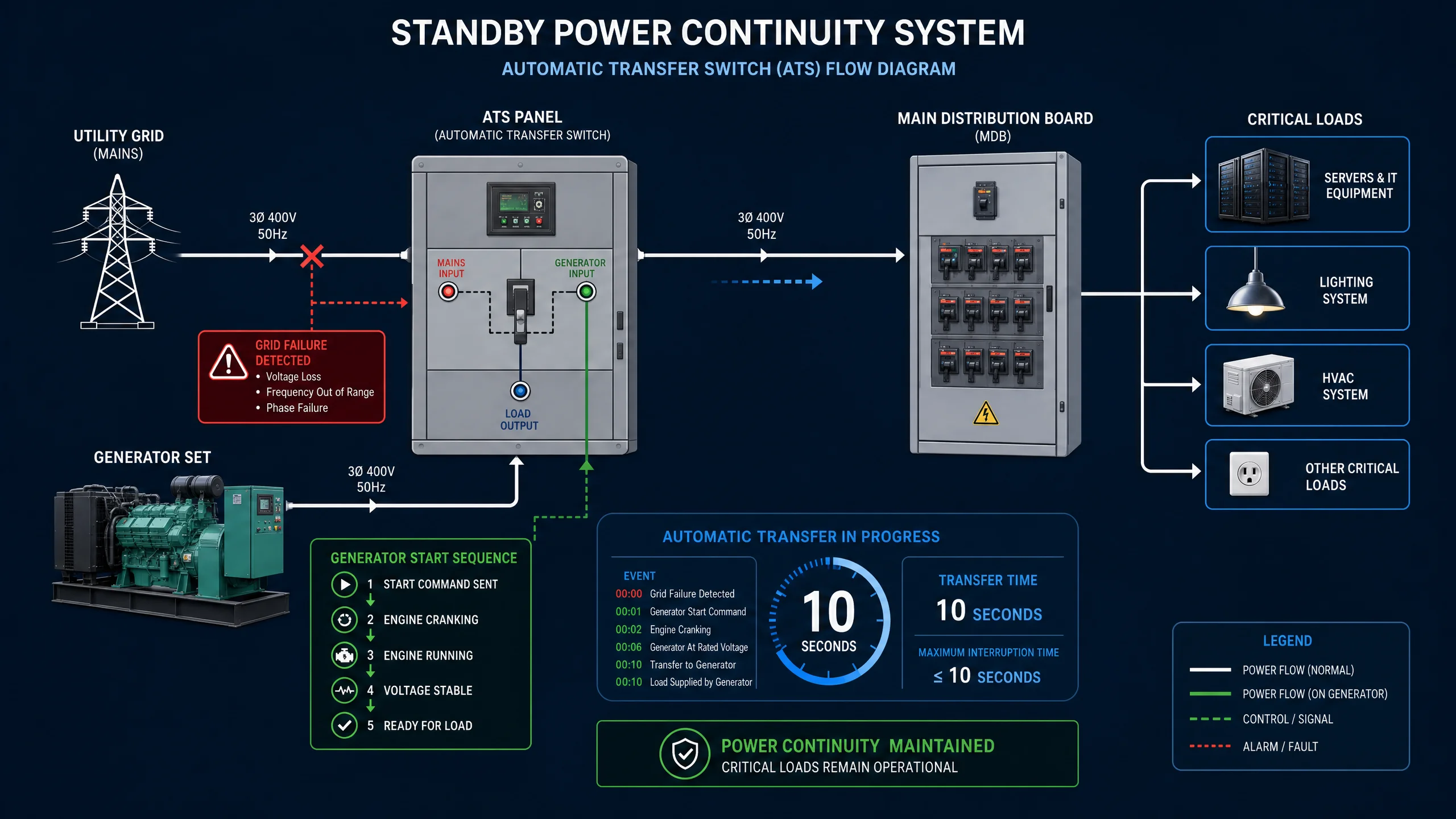
The Standby Power Continuity solution provides automatic backup power when the utility grid fails. The core system consists of a standby diesel generator, Automatic Transfer Switch (ATS), distribution panel, exhaust system, ventilation, fuel system, and monitoring. When grid power fails, the ATS detects the outage, signals the generator to start, and transfers the load within 10-30 seconds. When grid power is restored, the ATS transfers the load back and the generator cools down before shutting off.
Design Considerations
Key Engineering Challenges
Load Sizing & Starting Current
The generator must handle the running load and the inrush current of motors and other high-starting-current equipment.
ATS Transfer Logic
The ATS must correctly detect grid loss, coordinate with generator start delay, and manage re-transfer without load interruption.
Fuel Autonomy
Tank capacity must match the required runtime. Typical targets: 8 hours for commercial, 24-72 hours for critical facilities.
Exhaust & Ventilation
Generator room must have adequate airflow for combustion air intake and heat removal from engine cooling.
Noise & Vibration
Acoustic enclosures and anti-vibration mounts reduce noise impact on building occupants and neighbors.
Testing & Maintenance
Regular load testing and scheduled maintenance ensure the system will perform when needed.
Component Overview
System Architecture
A complete standby power system integrates the generator with ATS, distribution, fuel, exhaust, and monitoring subsystems.
01
Standby Diesel Generator
Engine-alternator set sized for standby duty. AMF controller monitors grid and manages automatic start/stop.
02
Automatic Transfer Switch (ATS)
Detects grid failure, initiates generator start, and transfers load. Manages re-transfer when grid is restored.
03
Control Panel
AMF controller monitors grid voltage/frequency, manages start sequences, and provides local/remote alarms.
04
Fuel Tanks
Day tank adjacent to generator plus main storage tank. Automatic fuel transfer maintains day tank level.
05
Exhaust System
Exhaust pipe, flexible bellows, silencer, and roof/wall penetration to route combustion gases to atmosphere.
06
Ventilation & Cooling
Louvres, fans, and ductwork to maintain adequate airflow for combustion and engine cooling.
Application Contexts
Deployment Scenarios
Commercial Buildings
Lifts, fire pumps, emergency lighting, and IT systems require reliable standby power during grid outages.
Hospitals & Healthcare
Life-safety systems, operating theatres, and medical equipment require uninterrupted power with fast transfer times.
Data Centers
Generator backup with UPS bridge for IT loads. Typically N+1 generator configuration for redundancy.
Industrial Facilities
Process equipment and safety systems require standby power to prevent production loss and safety incidents.
Project Workflow
Implementation Steps
1
Load Survey
Identify all backup loads and calculate required kVA including starting current allowance.
2
System Design
Select generator, ATS, distribution panel, and fuel system. Design exhaust and ventilation.
3
Installation & Commissioning
Install generator, connect ATS, and conduct starting and transfer tests.
4
Load Test & Handover
Conduct full load test and verify ATS transfer time. Document all settings and test results.
5
Scheduled Maintenance
Monthly no-load run, quarterly load test, annual full service.
Product Categories
Recommended Products
Standby Diesel Generators
Fixed units 20kW-2000kW with AMF controller for automatic standby operation.
Transfer Switches
2P/3P/4P ATS panels for automatic load transfer between grid and generator.
Control Panels
AMF controllers and remote monitoring interfaces for generator management.
Fuel Systems
Tanks, pumps, filters, and level sensors for reliable fuel supply.