EN English
CN 中文
FR Français
ES Español
PT Português
RU Русский
Generator Solution Framework

Hospital Emergency Power

Life-safety emergency generator systems for hospitals, clinics, and healthcare facilities. NFPA 99/110 compliant systems restore power to operating rooms, ICU, and critical life-support equipment within 10 seconds of any grid failure.

Life-Safety Power for Healthcare Facilities

Hospitals and healthcare facilities operate under the most stringent emergency power requirements of any building type. NFPA 99 (Health Care Facilities Code) and NFPA 110 (Emergency and Standby Power Systems) mandate that emergency power be restored within 10 seconds for life safety loads including operating rooms, ICU, emergency lighting, medical gas systems, fire alarm, and communications. A power failure in a hospital can directly endanger patient lives. SolutionMall provides complete NFPA 99/110 compliant emergency power systems for healthcare facilities from small clinics to large hospital campuses.
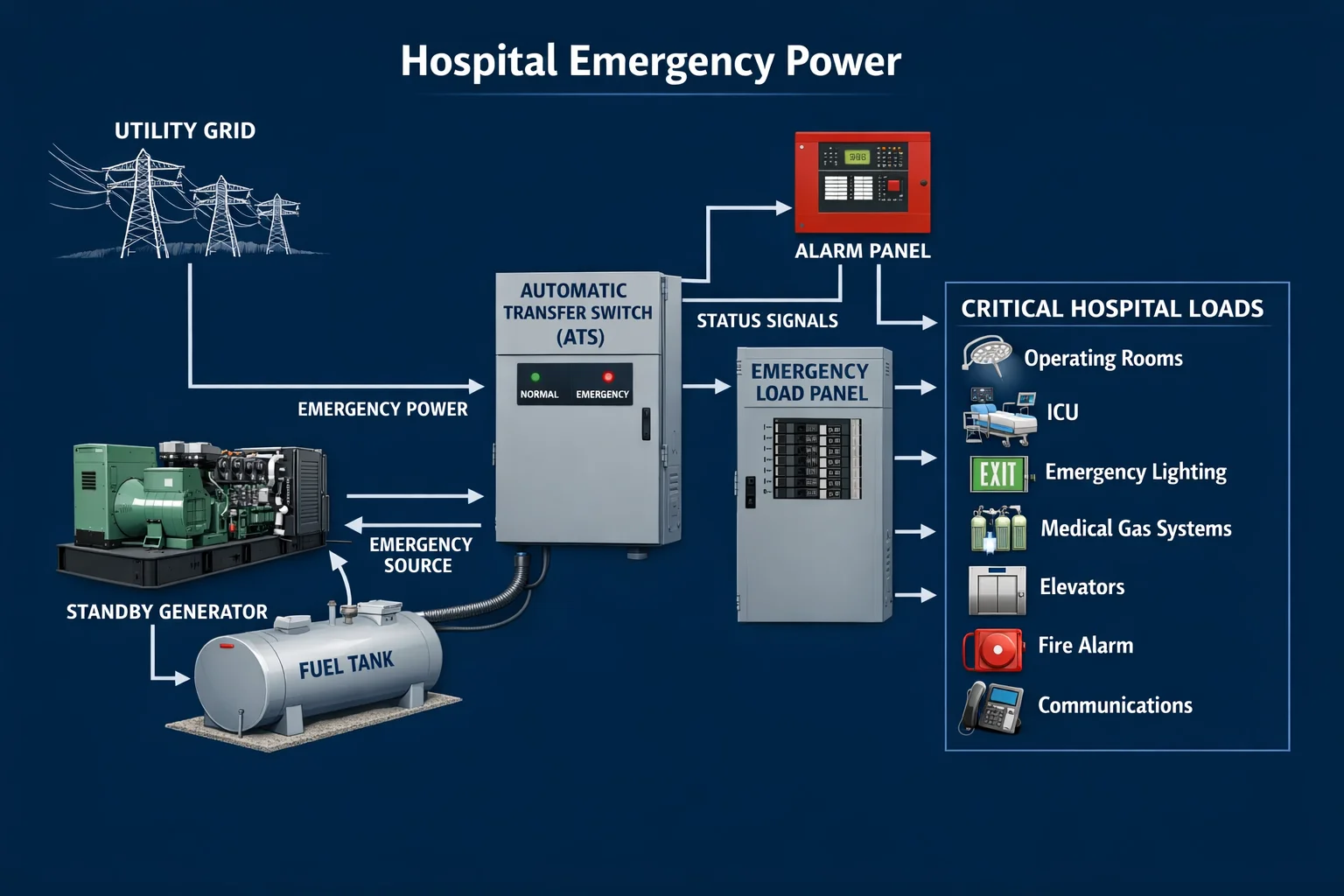
Hospital Emergency Power

Hospital Emergency Power Challenges

10-Second Transfer Requirement
NFPA 99 mandates that emergency power be restored within 10 seconds for Category 1 life safety loads. Generator start time and ATS transfer speed must be verified and documented.
Load Classification
Hospital loads are classified into Essential Electrical System (EES) branches: Life Safety Branch, Critical Branch, and Equipment Branch. Each has different transfer time and reliability requirements.
Redundancy Requirements
Hospitals typically require N+1 or 2N generator redundancy to ensure no single point of failure can interrupt emergency power supply.
Fuel Reliability
NFPA 110 requires minimum 96-hour fuel supply for Level 1 systems. Fuel quality management and emergency fuel delivery contracts are essential.
Maintenance Without Interruption
Generators must be maintainable without interrupting power to critical loads. Bypass isolation switches and redundant systems enable maintenance under load.
Regulatory Compliance
Healthcare facilities are subject to Joint Commission inspections, NFPA 99/110 compliance testing, and local authority having jurisdiction (AHJ) requirements.

Hospital Emergency Power System

The hospital emergency power system consists of one or more diesel generators connected to the Essential Electrical System (EES) through an Automatic Transfer Switch. The EES is divided into the Life Safety Branch (emergency lighting, fire alarm, egress), Critical Branch (operating rooms, ICU, nurse call), and Equipment Branch (HVAC, sterilizers, elevators). Each branch has its own ATS and distribution panel. A monitoring and alarm system provides continuous supervision of all system parameters.

01
Emergency Diesel Generator
Hospital-grade diesel generator set with Level 1 classification per NFPA 110. Fast start capability (10-second transfer), low-emission engine, and acoustic enclosure. Sized for full Essential Electrical System load.
02
Automatic Transfer Switch (Life Safety)
Bypass isolation ATS with 10-second maximum transfer time. Separate ATS for Life Safety Branch, Critical Branch, and Equipment Branch as required by NFPA 99.
03
Essential Electrical System Distribution
Dedicated distribution panels for each EES branch. Life Safety Branch feeds emergency lighting and fire alarm. Critical Branch feeds operating rooms and ICU. Equipment Branch feeds HVAC and elevators.
04
Fuel System (96-Hour Autonomy)
Day tank with automatic refilling from bulk storage. Bulk storage sized for minimum 96 hours at full load. Fuel polishing system for long-term storage quality.
05
Generator Monitoring and Alarm System
Continuous monitoring of generator status, fuel level, coolant temperature, oil pressure, and battery voltage. Alarm annunciation at nurse station and facility management system.
06
Bypass Isolation Switch
Allows generator and ATS maintenance without interrupting power to critical loads. Required for Level 1 systems per NFPA 110.

Healthcare Facility Applications

General Hospitals
Full Essential Electrical System with Life Safety, Critical, and Equipment branches. Multiple generators in N+1 configuration for large facilities.
Surgical Centers and Clinics
Simplified EES for operating rooms, recovery areas, and emergency lighting. Single generator with bypass isolation ATS.
Long-Term Care Facilities
Emergency power for resident life support equipment, emergency lighting, fire alarm, and HVAC in nursing homes and assisted living facilities.
Medical Office Buildings
Backup power for medical imaging equipment, laboratory refrigeration, and critical clinical systems in outpatient facilities.

Hospital Emergency Power Implementation

1
Healthcare Load Classification
Classify all electrical loads per NFPA 99: Life Safety Branch, Critical Branch, Equipment Branch, and non-essential loads. Document load schedule for each branch.
2
Generator Sizing and Redundancy
Size generator for full EES load including motor starting surge. Determine redundancy level (N+1 or 2N) based on facility criticality and regulatory requirements.
3
ATS Design and Compliance
Design ATS panels for each EES branch with appropriate transfer times. Verify compliance with NFPA 99 and 110 requirements and local AHJ requirements.
4
Fuel System Design
Calculate 96-hour fuel consumption. Design day tank, bulk storage, and fuel transfer system. Establish emergency fuel delivery contract.
5
Installation and Commissioning
Install generator, ATS panels, and distribution boards. Commission each component individually, then perform integrated system testing.
6
NFPA 110 Acceptance Testing
Conduct formal acceptance test per NFPA 110: 2-hour full load test, transfer time measurement, alarm and shutdown function verification, and fuel consumption documentation.

Products for Hospital Emergency Power

Hospital-Grade Diesel Generator
NFPA 110 Level 1 classified diesel generators with fast start capability, low emissions, and acoustic enclosure. Sized from 100 kVA to 2 MW.
Bypass Isolation ATS
Bypass isolation automatic transfer switches for healthcare facilities. Allows maintenance without load interruption. 10-second transfer time guaranteed.
Healthcare Monitoring System
Dedicated generator monitoring system with nurse station annunciation, facility management integration, and compliance reporting for Joint Commission inspections.
96-Hour Fuel Storage System
Bulk diesel storage tanks with fuel polishing, level monitoring, and automatic transfer pumps. Sized for NFPA 110 Level 1 compliance.

Design Your Hospital Emergency Power System

Submit your facility type and load classification. Our engineers will design a complete NFPA 99/110 compliant emergency power system for your healthcare facility.