
Fuel Management
Solution Overview
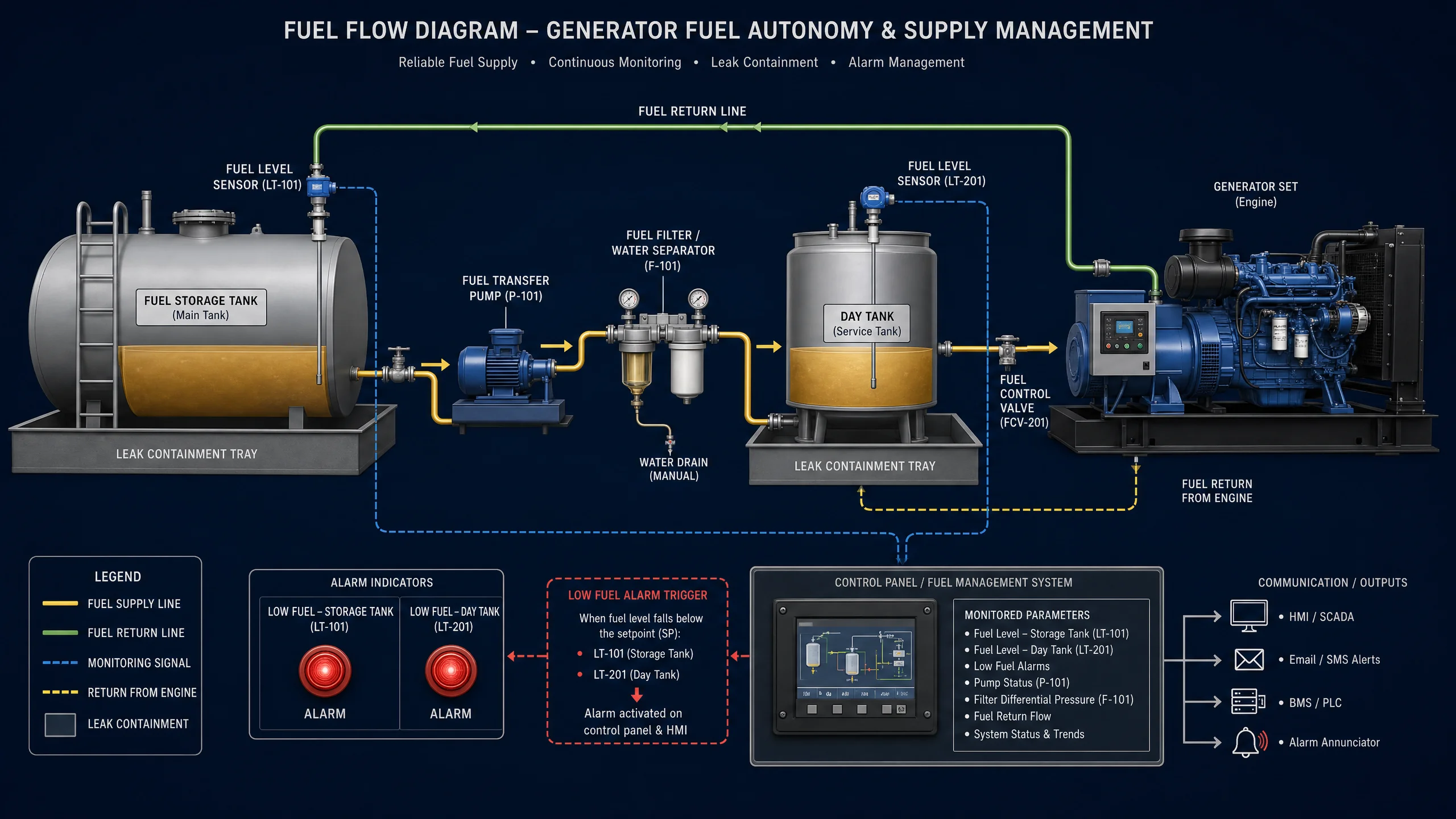
Fuel Autonomy & Storage Solutions address the critical challenge of ensuring generators have sufficient, clean fuel for their required runtime. The solution covers fuel storage tank design and sizing, fuel transfer systems, fuel quality management, environmental compliance (bunding and leak detection), and fuel monitoring. Proper fuel system design is essential for mission-critical applications where extended autonomy is required.
Design Considerations
Key Engineering Challenges
Autonomy Calculation
Required fuel volume depends on generator fuel consumption rate, load factor, and required runtime. Accurate calculation prevents fuel shortages.
Fuel Quality Degradation
Diesel fuel degrades over time, especially in hot climates. Fuel polishing, biocide treatment, and regular testing maintain fuel quality.
Environmental Compliance
Fuel storage must comply with environmental regulations: bunded containment, leak detection, and spill prevention are mandatory in most jurisdictions.
Fire Safety
Fuel storage near generators requires fire-rated construction, adequate separation distances, fire suppression, and compliance with fire codes.
Fuel Transfer Reliability
Day tank refill must be automatic and reliable. Pump failure or control fault can cause generator shutdown due to fuel starvation.
Tank Sizing Constraints
Available space, structural loading, and planning regulations may limit tank size. Multiple smaller tanks or underground storage may be required.
Component Overview
System Architecture
A complete fuel autonomy system integrates bulk storage tanks, fuel transfer pumps, day tanks, fuel polishing, level monitoring, and environmental containment.
01
Bulk Fuel Storage Tank
Above-ground or underground steel or polyethylene tanks sized for required autonomy. With bunded secondary containment.
02
Day Tank
Small tank adjacent to generator providing 8-24 hours of fuel. Automatically refilled from bulk storage.
03
Fuel Transfer Pump System
Automatic pump system transfers fuel from bulk tank to day tank based on level signals. Includes duty/standby pumps.
04
Fuel Polishing System
Continuous or periodic fuel filtration and water removal to maintain fuel quality in storage tanks.
05
Level Monitoring & Alarms
Ultrasonic or float-type level sensors with local and remote alarms for low fuel, high fuel, and leak detection.
06
Bunded Containment
Secondary containment bund around fuel tanks to capture spills and leaks. Sized to 110% of largest tank volume.
Application Contexts
Deployment Scenarios
Data Centers
Tier III/IV data centers require 24-72 hours of fuel autonomy with N+1 fuel delivery paths and continuous fuel quality monitoring.
Hospitals & Critical Care
Healthcare facilities require extended fuel autonomy for emergency operations with automatic fuel management and quality assurance.
Remote Off-Grid Sites
Mining, oil & gas, and remote infrastructure sites require large bulk fuel storage with infrequent delivery logistics.
Emergency Response Facilities
Emergency operations centers and disaster response facilities require extended fuel autonomy with rapid refueling capability.
Project Workflow
Implementation Steps
1
Autonomy Requirement Analysis
Determine required runtime, calculate fuel consumption, define delivery frequency, and establish minimum reserve levels.
2
Tank Sizing & Selection
Size bulk and day tanks for required autonomy plus safety margin. Select tank type, material, and configuration.
3
System Design & Compliance
Design fuel transfer, level monitoring, bunding, and fire safety systems. Obtain environmental and fire safety permits.
4
Installation & Testing
Install tanks, pumps, piping, and controls. Test all transfer sequences, level alarms, and leak detection systems.
5
Fuel Management Procedures
Establish fuel testing schedule, polishing intervals, delivery procedures, and emergency refueling protocols.
Product Categories
Recommended Products
Bulk Fuel Storage Tanks
Above-ground and underground fuel tanks from 1,000L to 100,000L with bunded secondary containment.
Fuel Transfer Systems
Automatic fuel transfer pump systems with duty/standby pumps, level controls, and alarms.
Fuel Polishing Systems
Continuous fuel filtration and water removal systems to maintain diesel fuel quality in storage.
Fuel Level Monitoring
Ultrasonic and float-type level sensors with IoT connectivity for remote fuel level monitoring and alerts.