EN English
CN 中文
FR Français
ES Español
PT Português
RU Русский
Generator Solution Framework

Disaster Response Emergency Power

Rapid-deployment portable and trailer-mounted generators for disaster response, emergency relief operations, and humanitarian missions. Power for emergency lighting, water pumps, communication systems, temporary medical facilities, and rescue equipment—deployable within hours.

Rapid Power Deployment for Emergency Response

Natural disasters—earthquakes, floods, typhoons, and wildfires—destroy utility infrastructure and leave communities without power for days or weeks. Emergency response operations require immediate, reliable power for rescue operations, temporary medical facilities, water supply, communication, and public safety. The power system must be rapidly deployable, operable by non-specialist personnel, and capable of running on locally available fuel. SolutionMall provides a complete range of portable generators, trailer generators, temporary distribution equipment, and lighting towers for disaster response and emergency relief operations.
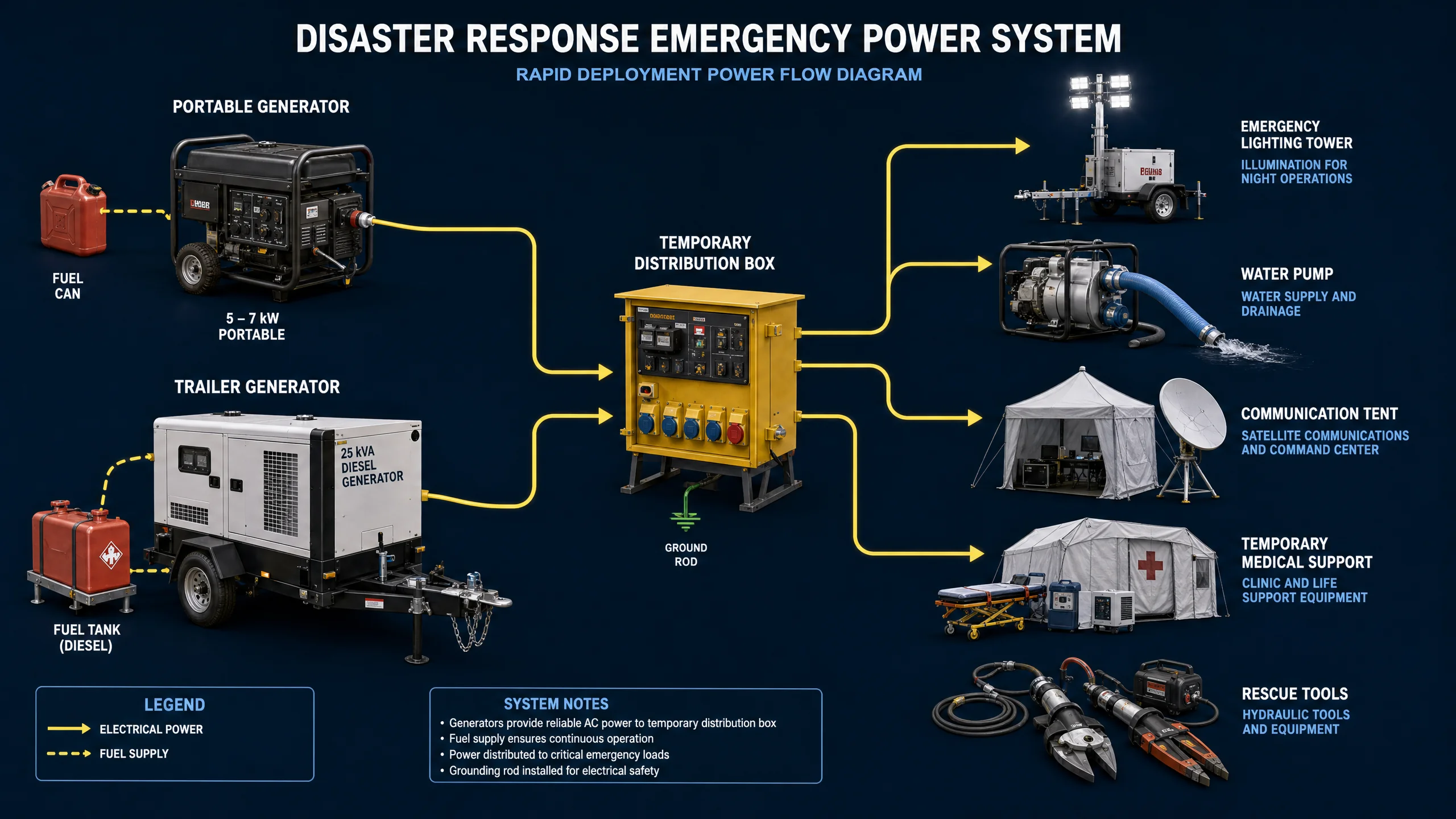
Disaster Response Emergency Power

Disaster Response Power Challenges

Rapid Deployment Requirement
Emergency power must be operational within hours of a disaster event. Equipment must be pre-positioned, easy to transport, and quick to connect without specialist tools.
Fuel Availability Uncertainty
Fuel supply chains are often disrupted after disasters. Generators must be fuel-flexible (gasoline and diesel), and fuel storage must be pre-positioned with emergency supplies.
Non-Specialist Operation
Emergency power equipment may be operated by volunteers or military personnel without electrical training. Equipment must be simple to operate with clear instructions and automatic safety shutdowns.
Harsh Field Conditions
Disaster response occurs in damaged, flooded, or debris-filled environments. Equipment must be robust, weatherproof, and operable in extreme conditions.
Multiple Simultaneous Power Needs
Emergency operations require power simultaneously for lighting, water pumps, communications, medical equipment, and rescue tools. Distribution must prioritize life-safety loads.
Equipment Accountability
Emergency equipment deployed to disaster zones must be tracked and recovered. Rugged labeling, inventory management, and GPS tracking are important for large deployments.

Disaster Response Power System

The disaster response power system is modular and scalable. Portable generators (5–10 kW) provide immediate power for small operations. Trailer generators (20–100 kW) power larger command posts and medical facilities. A temporary distribution box connects the generator to multiple load circuits. Emergency lighting towers provide area illumination for night operations. All equipment is designed for rapid deployment by small teams.

01
Portable Generator 5–10 kW
Compact, lightweight portable generators for immediate deployment. Gasoline or diesel fuel, electric start, GFCI outlets, and low-oil shutdown. Operable by non-specialist personnel.
02
Trailer Generator 20–100 kW
Diesel generator on a road-towable trailer for larger emergency operations. Three-phase output, weatherproof enclosure, built-in fuel tank for 8–24 hours, and remote start capability.
03
Temporary Distribution Box
Weatherproof distribution box with multiple outlet types for different emergency loads. RCD protection on all circuits, lockable enclosure, and clear circuit labeling.
04
Emergency Lighting Tower
Diesel or electric lighting tower with LED floodlights. Provides 1000–5000 lux area illumination for night rescue operations. Mast height 6–9m, 360° rotation.
05
Water Pump Power Supply
Dedicated power circuit for dewatering and water supply pumps. Includes appropriate cable and connectors for pump connection in wet conditions.
06
Fuel Storage and Transfer
Portable fuel cans (20L), jerry cans (20L), and drum pumps for fuel storage and transfer. Sufficient for 48–72 hours of generator operation without resupply.

Disaster Response Applications

Earthquake Response
Immediate power for search and rescue lighting, communication equipment, and temporary medical triage areas. Trailer generators for field hospitals.
Flood Response
Power for dewatering pumps, emergency lighting, and communication systems. Waterproof equipment rated for operation in wet conditions.
Typhoon and Storm Recovery
Power for community shelters, emergency communication, and critical infrastructure repair teams. Multiple generators for extended operations.
Humanitarian Relief Operations
Power for refugee camps, temporary medical facilities, water purification systems, and communication centers in conflict or disaster zones.

Disaster Response Power Deployment

1
Pre-Positioning and Inventory
Maintain pre-positioned emergency power kits at strategic locations. Each kit includes portable generator, distribution box, cables, fuel, and operating instructions.
2
Rapid Site Assessment
On arrival at disaster site, assess power needs: rescue lighting, medical facility, water pumps, communication. Prioritize life-safety loads.
3
Generator Positioning and Grounding
Position generator upwind of operations area, away from enclosed spaces. Install grounding rod. Ensure adequate ventilation to prevent CO accumulation.
4
Distribution and Load Connection
Connect distribution box to generator. Connect priority loads first: emergency lighting, medical equipment, communication. Add additional loads as capacity allows.
5
Fuel Management
Monitor fuel level continuously. Establish fuel resupply schedule. Keep minimum 24-hour fuel reserve at all times. Coordinate with logistics for extended operations.
6
Handover to Local Authorities
Document all equipment deployed. Train local personnel in generator operation and basic maintenance. Establish fuel supply chain for extended recovery operations.

Products for Disaster Response Power

Portable Generator 5–10 kW
Compact portable generators for immediate emergency deployment. Gasoline or diesel, electric start, GFCI outlets, and automatic safety shutdowns.
Trailer Generator 20–100 kW
Diesel trailer generators for larger emergency operations. Weatherproof enclosure, built-in fuel tank, three-phase output, and remote start.
Emergency Lighting Tower
Diesel and electric lighting towers for night rescue operations. LED floodlights, 6–9m mast height, and 360° rotation for maximum area coverage.
Emergency Power Distribution Kit
Complete temporary distribution kit including distribution box, cable ramps, cables, and connectors. Designed for rapid deployment by non-specialist personnel.

Prepare Your Emergency Power Response

Submit your emergency response requirements. Our team will help you build a pre-positioned emergency power kit for rapid disaster response deployment.