EN English
CN 中文
FR Français
ES Español
PT Português
RU Русский
Generator Solution Framework

Data Center Backup Power

N+1 redundant diesel generator systems engineered for data center uptime requirements. Seamless UPS integration, fast automatic transfer, fuel autonomy management, and 24/7 remote monitoring for zero-tolerance IT infrastructure.

Zero-Downtime Power for Critical IT Infrastructure

Data centers operate under the strictest uptime requirements—Tier III and Tier IV facilities target 99.982% and 99.995% availability respectively. A single power outage can cost hundreds of thousands of dollars per minute in lost revenue, data corruption, and SLA penalties. The backup power system must bridge the gap between utility failure and generator stabilization (typically 10–30 seconds) using UPS battery banks, then sustain full IT load on generator power for hours or days. SolutionMall provides complete N+1 redundant generator systems, paralleling switchgear, fuel management, and monitoring solutions for data centers from 500 kW to 20 MW.
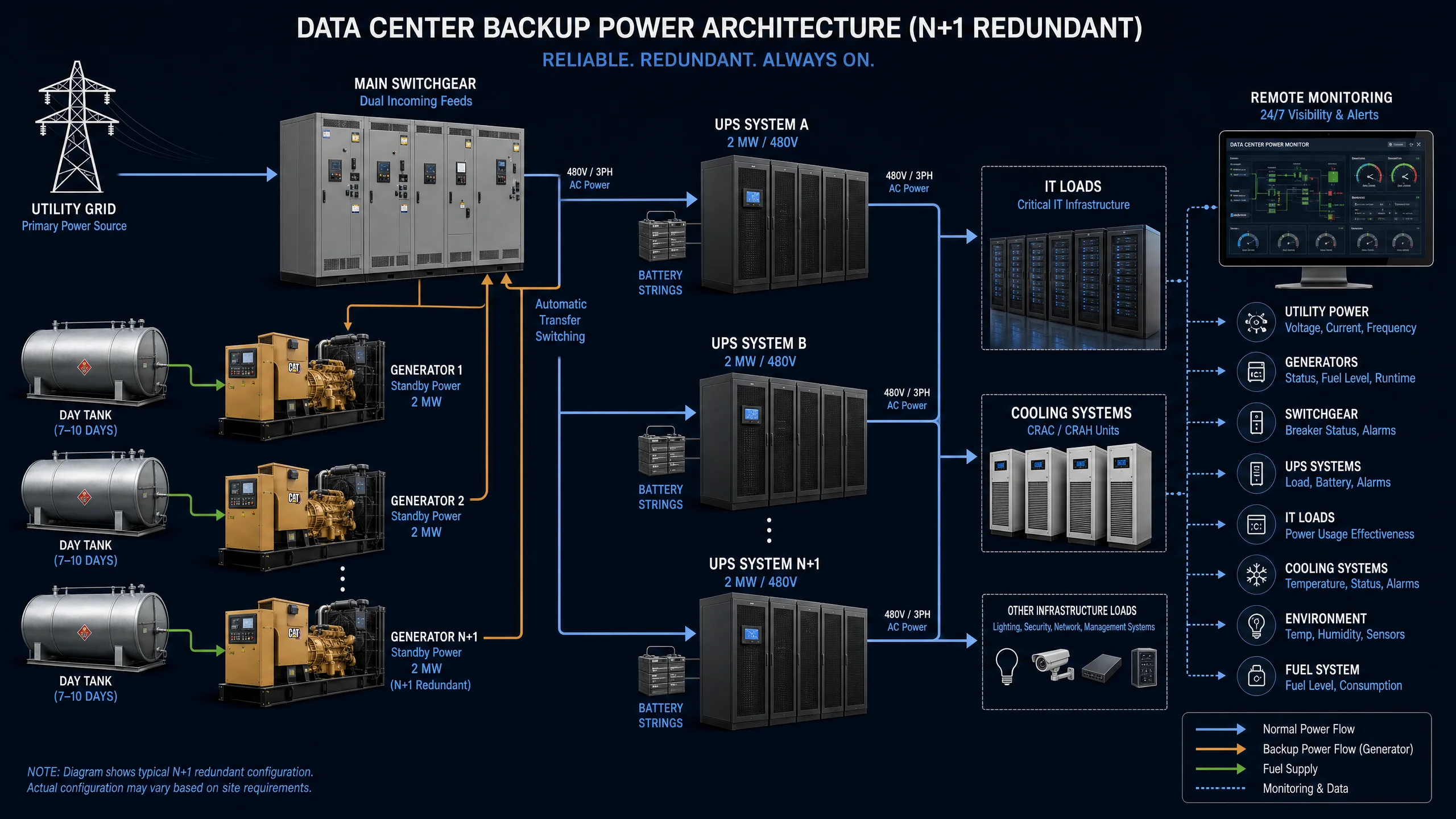
Data Center Backup Power

Data Center Power Challenges

Zero Transfer Gap Requirement
IT equipment cannot tolerate even momentary power interruption. UPS systems must bridge the 10–30 second gap between utility failure and generator stabilization.
N+1 Redundancy
Data centers require at least one generator more than the minimum needed. If any generator fails, remaining units must carry full load without interruption.
High Load Density
Modern data centers have PUE ratios of 1.2–1.5, with IT loads of 1–20 MW. Generator systems must handle high, continuous loads with minimal derating.
Fuel Autonomy
Extended outages require days of fuel supply. Bulk fuel storage, day tanks, and automated fuel transfer systems must be designed for minimum 72-hour autonomy.
Cooling System Integration
CRAC and CRAH cooling units represent 30–40% of total data center load. Backup power must include cooling to prevent thermal shutdown of IT equipment.
Generator Paralleling
Multiple generators must synchronize and share load precisely. Paralleling switchgear and governor/AVR compatibility are critical for stable operation.

Data Center N+1 Backup Power Architecture

The data center backup power architecture consists of multiple diesel generators connected to a paralleling switchgear. The switchgear feeds UPS systems which in turn power the IT loads and cooling systems. On utility failure, the UPS battery banks provide immediate power while generators start and synchronize. Once all generators are online and stable, the paralleling switchgear transfers load from UPS bypass to generator-backed utility. Remote monitoring provides 24/7 visibility of all system parameters.

01
Diesel Generator Sets (N+1)
High-reliability diesel generators rated for continuous duty. Typically 500 kW to 3 MW per unit. Equipped with electronic governors, AVR, and AMF controllers for fast, precise paralleling.
02
Paralleling Switchgear
Automatic paralleling switchgear that synchronizes multiple generators, shares load proportionally, and manages load transfer. Includes bus protection and generator protection relays.
03
UPS Systems
Double-conversion UPS systems with battery banks providing 10–30 minutes of runtime at full IT load. Bridges the gap between utility failure and generator stabilization.
04
Fuel Day Tanks
500–5000L day tanks per generator with automatic fuel transfer from bulk storage. Level sensors trigger automatic refilling to maintain minimum 8-hour reserve.
05
Bulk Fuel Storage
Above or below-ground bulk diesel storage tanks providing 72+ hours of fuel autonomy. Includes fuel polishing system to maintain fuel quality.
06
Remote Monitoring Platform
SCADA-based monitoring system with real-time dashboards, alarm management, fuel consumption tracking, and predictive maintenance analytics.

Data Center Power Applications

Hyperscale Data Centers
20+ MW facilities requiring 8–16 generators in N+1 or 2N configuration. Paralleling switchgear with automatic load sharing and fault isolation.
Enterprise Data Centers
1–5 MW corporate data centers with 2–4 generators in N+1 configuration. Integrated with existing UPS and cooling infrastructure.
Colocation Facilities
Multi-tenant facilities with separate power metering and backup systems per tenant. Shared generator infrastructure with dedicated UPS per tenant.
Edge Data Centers
Smaller facilities (100–500 kW) in remote locations requiring high reliability with limited maintenance access. Containerized generator and UPS solutions.

Data Center Backup Power Implementation

1
Power Architecture Design
Define redundancy level (N+1, 2N), calculate IT load and cooling load, determine UPS runtime requirements, and design fuel autonomy strategy.
2
Generator and Switchgear Selection
Select generators with compatible governors and AVR for paralleling. Design paralleling switchgear with appropriate protection relays and bus configurations.
3
UPS Integration Planning
Coordinate generator transfer time with UPS battery runtime. Ensure generator voltage and frequency stability meets UPS input requirements.
4
Fuel System Design
Design day tank sizes, bulk storage capacity, fuel transfer pump sizing, and fuel polishing system for long-term fuel quality maintenance.
5
Installation and Commissioning
Install generators, paralleling switchgear, and monitoring systems. Perform individual generator commissioning, then parallel operation testing at full load.
6
Acceptance Testing
Conduct formal acceptance test including: utility failure simulation, generator start and transfer time measurement, full load test at N+1 configuration, and fuel consumption verification.

Products for Data Center Backup Power

High-Reliability Diesel Generator 500 kW–3 MW
Data center-grade diesel generators with electronic governors, AVR, and AMF controllers. Designed for fast paralleling and continuous duty operation.
Automatic Paralleling Switchgear
Microprocessor-based paralleling switchgear for 2–16 generators. Automatic synchronization, load sharing, and fault isolation.
Fuel Management System
Automated fuel transfer and monitoring system. Day tank level control, bulk storage management, fuel consumption reporting, and leak detection.
SCADA Monitoring Platform
Cloud-based SCADA system for data center power infrastructure. Real-time dashboards, alarm management, and predictive maintenance analytics.

Design Your Data Center Backup Power System

Submit your IT load profile and uptime requirements. Our engineers will design a complete N+1 redundant backup power system for your data center.