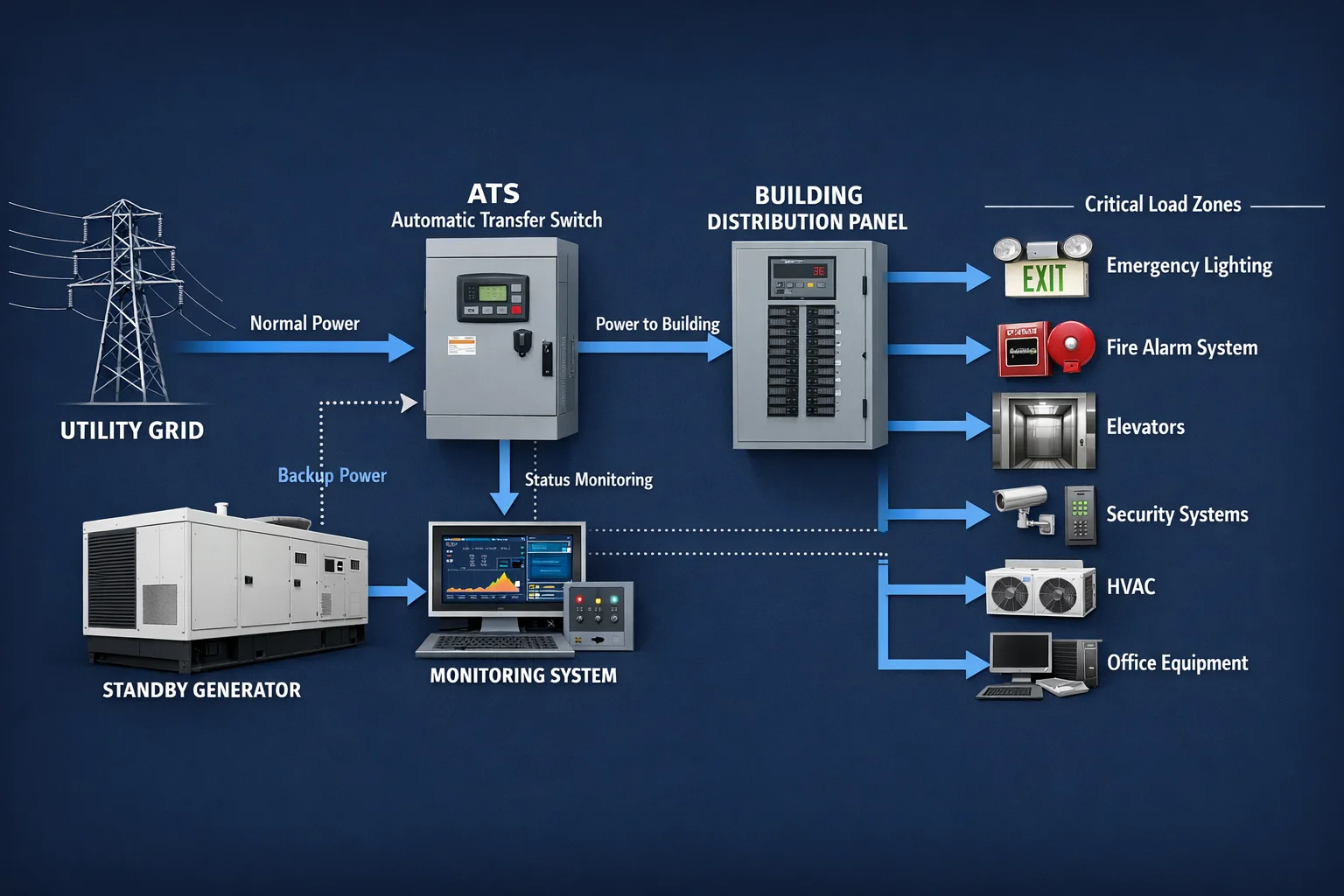
Automatic standby generator systems that protect commercial buildings from power outages. Seamless ATS switching ensures elevators, fire alarms, security, lighting, and HVAC remain operational during grid failures.
COMMERCIAL BACKUP
Protecting Business Continuity in Commercial Buildings
Commercial buildings—offices, retail centers, hotels, and mixed-use developments—face significant financial and safety risks during power outages. Elevators trap occupants, fire alarm systems lose power, access control fails, and HVAC systems shut down. A properly designed standby generator system with an Automatic Transfer Switch (ATS) restores power to critical loads within 10–30 seconds of a grid failure, protecting both occupants and business operations. SolutionMall supplies complete backup power systems including generators, ATS panels, distribution boards, and remote monitoring for commercial buildings from 50 kVA to 2 MW.
KEY CHALLENGES
Backup Power Challenges in Commercial Buildings
⚠
Life Safety Load Compliance
Building codes require emergency power for fire alarms, exit lighting, and elevators within 10 seconds of outage. Generator sizing and ATS speed must meet NFPA 110 or equivalent standards.
⚠
Space Constraints
Urban commercial buildings often have limited plant room space. Generator selection must balance power output with physical footprint and acoustic requirements.
⚠
Acoustic Impact
Generators near occupied spaces or in noise-sensitive areas require acoustic enclosures and anti-vibration mounts to meet local noise ordinances.
⚠
Fuel Storage Regulations
On-site diesel storage in commercial buildings is subject to fire code restrictions on tank capacity and location. Compliance with NFPA 30 or local equivalents is required.
⚠
Maintenance Access
Generators installed in basements or plant rooms must have adequate access for maintenance, oil changes, and major overhauls.
⚠
Load Shedding Strategy
Not all building loads can be backed up. A clear load priority matrix must be defined to stay within generator capacity during outages.
SYSTEM ARCHITECTURE
Commercial Building Backup Power System
The system consists of a standby diesel generator connected to an ATS panel. During normal operation, the ATS feeds the building distribution board from the utility grid. On grid failure, the ATS signals the generator to start, and transfers the load to generator power once stable voltage and frequency are confirmed. A monitoring system provides remote visibility of generator status, fuel level, and alarm conditions.
01
Standby Diesel Generator
50 kVA to 2 MW diesel generator set in acoustic enclosure. Automatic start on ATS signal, rated for standby duty cycle. Includes day tank, exhaust system, and battery charger.
02
Automatic Transfer Switch (ATS)
Open or closed transition ATS panel. Monitors utility voltage and frequency, initiates generator start on failure, transfers load within 10–30 seconds, retransfers on utility restoration.
03
Building Distribution Board
Main LV switchboard with metering, protection, and distribution to sub-boards for each floor or zone. Includes emergency load priority circuits.
04
Remote Monitoring System
IoT-based monitoring panel with cloud connectivity. Provides real-time generator status, fuel level, runtime hours, alarm notifications, and maintenance scheduling.
05
Acoustic Enclosure
Sound-attenuated generator enclosure reducing noise to 65–75 dB(A) at 1m. Required for urban commercial buildings near occupied spaces.
06
Day Tank and Fuel System
500–2000L day tank with level sensor and automatic fuel transfer pump. Ensures minimum 8–24 hours of operation without manual fuel delivery.
DEPLOYMENT SCENARIOS
Commercial Building Applications
Office Towers
Backup power for emergency lighting, fire alarm, elevators, server rooms, and security systems. Load shedding strategy to stay within generator capacity.
Shopping Malls and Retail Centers
Protection for refrigeration, security, emergency lighting, and POS systems. Parallel generator sets for larger malls requiring 500 kVA to 2 MW.
Hotels and Hospitality
Full backup for guest rooms, restaurants, HVAC, elevators, and security. Guest experience continuity during outages.
Mixed-Use Developments
Separate ATS circuits for residential, commercial, and retail zones with different load priority requirements.
IMPLEMENTATION STEPS
Commercial Building Backup Power Implementation
1
Load Survey and Priority Matrix
Survey all electrical loads in the building. Categorize into Life Safety (mandatory backup), Essential (high priority), and Non-Essential (shed during outage).
2
Generator Sizing
Calculate total essential load. Size generator at 110–125% of essential load. Consider future expansion and motor starting surge currents.
3
ATS and Distribution Design
Design ATS panel and emergency distribution board. Ensure ATS transfer time meets code requirements for life safety loads.
4
Installation and Civil Works
Prepare generator room with adequate ventilation, exhaust routing, fuel storage, and anti-vibration mounting. Install ATS and distribution boards.
5
Commissioning and Load Testing
Perform full load test at 100% rated capacity for minimum 2 hours. Test ATS transfer time and retransfer. Verify all alarm and shutdown functions.
6
Handover and Maintenance Plan
Provide operation and maintenance manuals. Establish weekly no-load test schedule and annual full-load test. Set up remote monitoring alerts.
RECOMMENDED PRODUCTS
Products for Commercial Building Backup
⚡
Standby Generator 100–2000 kVA
Acoustic-enclosed diesel generator sets for commercial standby duty. Automatic start, AMF controller, and remote monitoring interface.
⚡
Automatic Transfer Switch Panel
Open and closed transition ATS panels from 100A to 4000A. Programmable transfer time, load shedding outputs, and remote monitoring.
⚡
Remote Monitoring System
Cloud-based generator monitoring with mobile app, email/SMS alerts, fuel level tracking, and maintenance scheduling.
⚡
Acoustic Generator Enclosure
Factory-fitted acoustic enclosures achieving 65–75 dB(A) at 1m. Available for all major generator brands and sizes.
Protect Your Commercial Building from Outages
Submit your building load schedule and our engineers will design a complete backup power system with ATS, distribution, and monitoring.